
What Pension Will I Get? A Straight Answer for UK Professionals
What pension will I get?
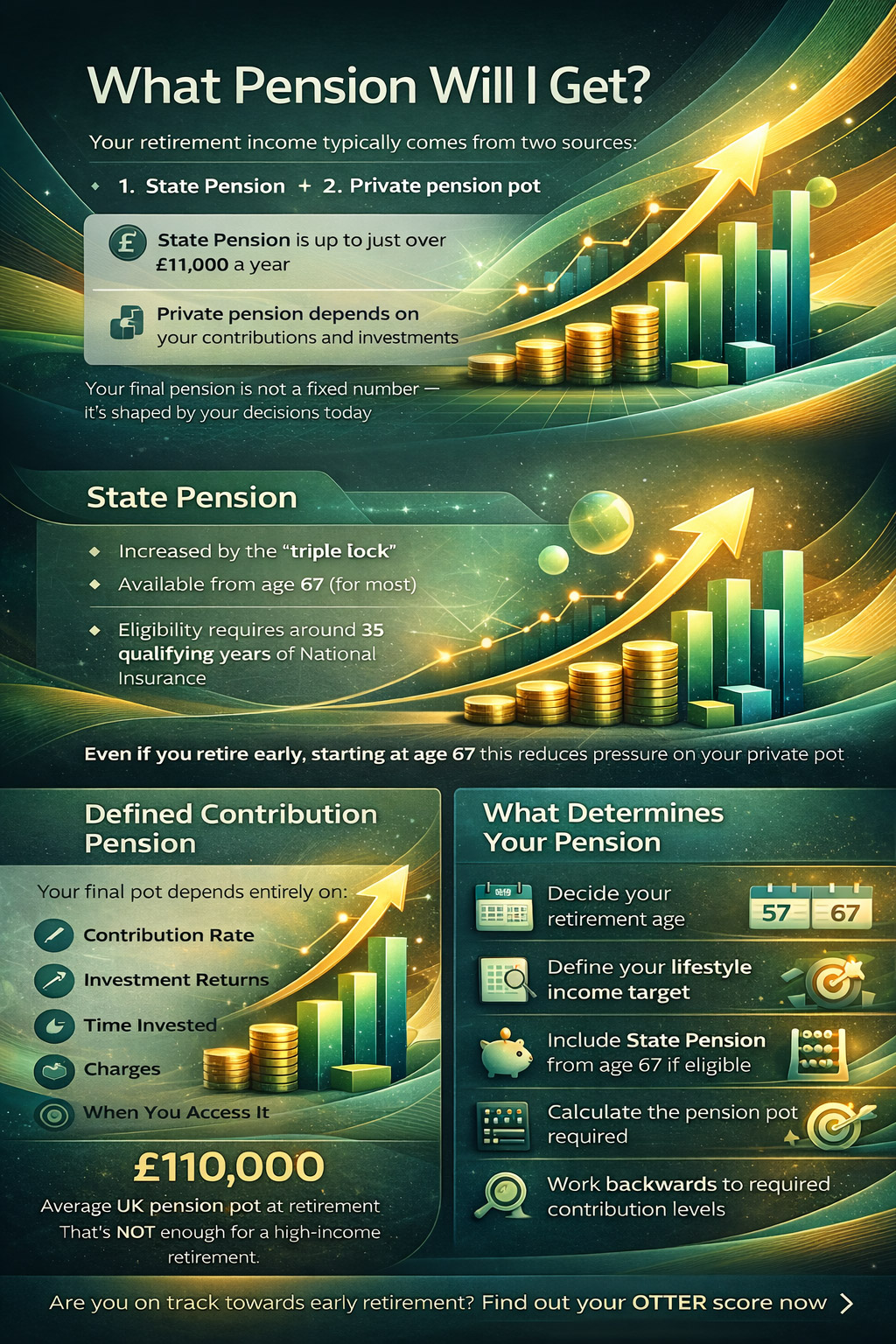
If you are in the UK with a defined contribution pension, your retirement income will usually come from two sources: your private pension pot and the State Pension. The State Pension currently provides up to just over £11,000 per year if you have enough qualifying National Insurance years. Your private pension income depends entirely on how much you contribute, how it is invested, and how long it compounds. Most people underestimate how much they will need and overestimate what they will receive. The average UK pension pot at retirement is far lower than most assume. Your final pension is not a fixed number. It is the outcome of decisions you make today.
Now let’s unpack it properly.
What Pension Will I Get From the State Pension?
If you qualify for the full new State Pension, you currently receive just over £11,000 per year. This will change with time so visit the official government website to check: https://www.gov.uk/browse/working/state-pension
To receive the full amount you need around 35 qualifying years of National Insurance contributions. Fewer years means a reduced pension.
Important points:
You cannot usually claim it before State Pension age, currently around 66 to 67 depending on birth year
It increases each year under the triple lock policy
It provides inflation-linked, guaranteed income for life
Here is the crucial part for early retirement planning.
If you retire at 57, you will not receive the State Pension for around 10 years. But from age 67 onwards, that income reduces the pressure on your private pension pot significantly.
In my own planning, targeting retirement at 57, I fully include the State Pension from age 67 onwards. Ignoring it would dramatically overstate the pension pot required.
What Pension Will I Get From a Defined Contribution Pension?
Most UK professionals today are in defined contribution pensions.
A defined contribution pension means:
You and your employer contribute
The money is invested
Your final pot depends on contributions and investment growth
This is different from a defined benefit pension, which promises a fixed income based on salary and years of service. These are now rare outside parts of the public sector.
With defined contribution pensions, there are no guarantees. Your outcome depends on:
Contribution rate
Investment returns
Time invested
Charges
When you access it
In my 8 years working in the industry as a fund analyst overseeing thousands of funds, I have seen how small differences in asset allocation compound into life-changing differences over decades.
The uncomfortable truth is this: most people do not know what their pension is projected to deliver.
The Wake-Up Call: Average UK Pension Pot Sizes
If you are asking “what pension will I get?”, here is the reality.
The average UK defined contribution pension pot at retirement is often quoted at around £100,000 to £120,000.
That level of savings does not support a high-income retirement.
Assume £110,000 as a rough pot size. Even with careful withdrawals, that is unlikely to generate more than a modest income alongside the State Pension.
This is why so many people feel financial pressure later in life.
They assumed it would “work out”.
It rarely does without intention.
What Pension Will I Get If I Retire at 57 Instead of 67?
This is where it becomes interesting.
Let’s compare two scenarios:
Scenario A: Retire at 67
You access private pension and State Pension at roughly the same time
Your private pension only needs to support you from 67 onwards
Scenario B: Retire at 57
Your private pension must fund 10 years before the State Pension starts
From 67 onwards, State Pension reduces pressure on your private pot
That 10-year bridge is the key planning challenge.
But here is the flip side.
Retiring 10 years earlier means:
10 additional years of freedom
10 years while you are younger and more active
10 years to travel, build, volunteer, create
When my wife and I talk about retiring at 57, what hits me is not the number. It is the reality that we would still be young enough to use that freedom.
The pension you will get is shaped by whether you plan for 67 or 57.
Like the famous Zig Ziglar quote “Aim at nothing, you’ll hit it every time”.
What Pension Will I Get Depends on What You Actually Need
One of the biggest misconceptions in retirement planning is assuming you need your full salary.
You do not.
Your retirement income is about lifestyle income, not gross salary.
For many UK professionals:
Mortgage may be paid off
Pension contributions stop
National Insurance contributions stop
Work-related expenses disappear
This means the income required to sustain your lifestyle is often significantly lower than your working salary.
Understanding this reduces the pension pot required and makes early retirement more achievable than most think.
But you need clarity.
Without defining:
What age you want to retire
What income you want in retirement
Whether you include the State Pension
You cannot answer “what pension will I get” in a meaningful way.
A Simple Framework to Answer “What Pension Will I Get?”
If you want control, follow this sequence:
Decide your retirement age
Define your lifestyle income target
Include State Pension from age 67 if eligible
Calculate the pension pot required to bridge any early retirement gap
Work backwards to required contribution levels
This is exactly the thinking behind the OTTER approach.
On Track Towards Early Retirement.
It is not about guessing.
It is about defining the target and reverse engineering the path.
My Personal Perspective
As a CFA Charterholder working in pension fund performance analysis, and someone planning to retire at 57, I can tell you this:
Most people are not under-saving because they are reckless.
They are under-saving because they have never defined the outcome.
When I built my own projections, including the State Pension from age 67, the numbers became tangible. The path became clear. The anxiety reduced.
Clarity creates confidence.
Uncertainty creates drift.
What Pension Will I Get? The Honest Answer
You will get:
A State Pension if you qualify
Whatever your defined contribution pot can support
The outcome of your current contribution and investment decisions
If you do not calculate it, you are guessing.
And guessing with your largest future asset is not a strategy.
Are you guessing what pension you will get? Or do you know?
Most professionals are walking towards retirement blindfolded.
If you want to know whether you are On Track Towards Early Retirement, calculate your OTTER Score.
Stop guessing.
Start measuring.
Certainty is not someday. It is OTTER.