
See Our Latest Blogs
Dive into our latest blogs for practical tips and insights to ensure a secure and comfortable retirement. Your future begins now!

How pensions are calculated
How pensions are calculated
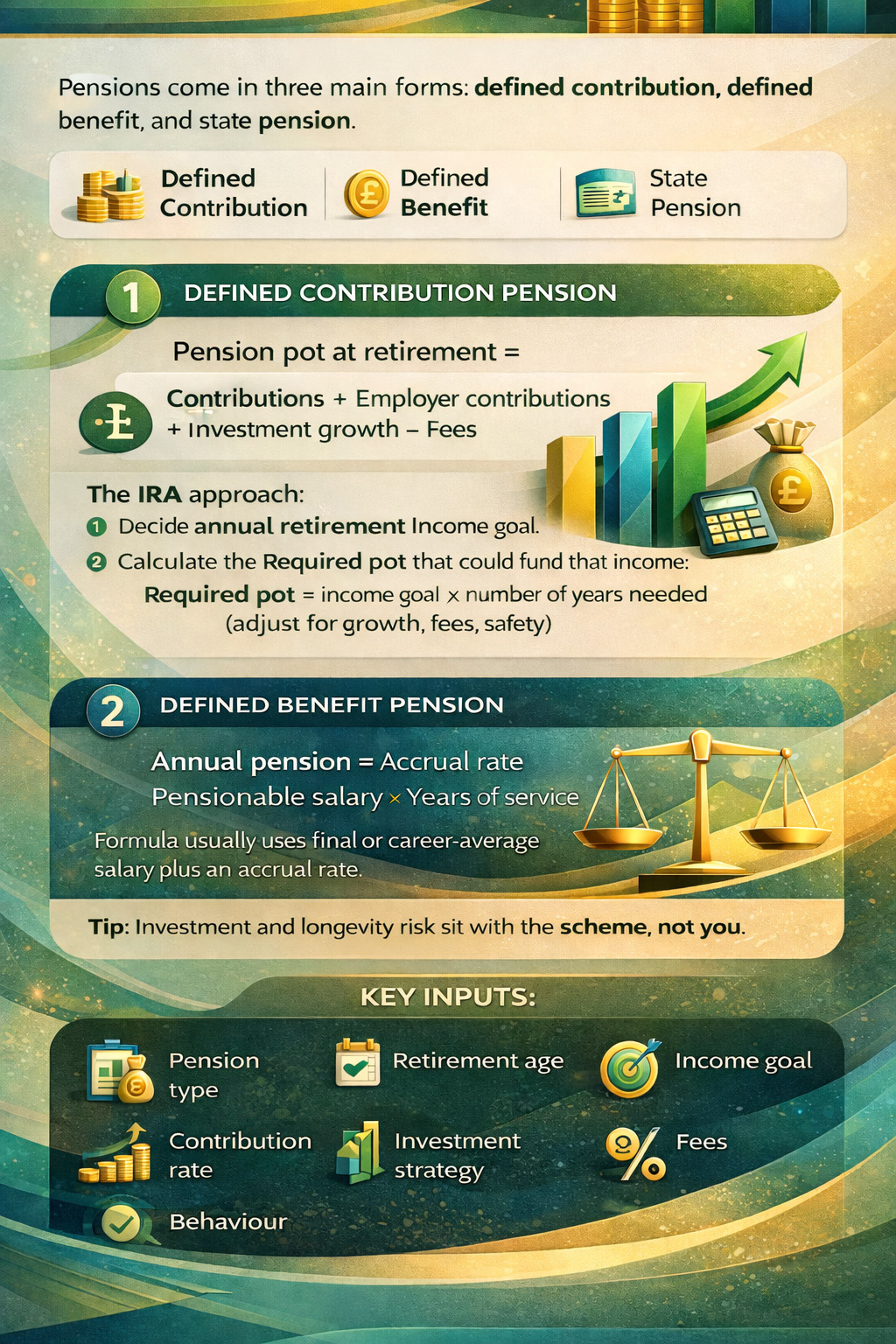
Pensions are calculated in three main ways. A defined contribution (DC) pension is calculated by building a pension pot: contributions (you and employer) plus investment growth, minus fees, then converting that pot into retirement income through pension drawdown or an annuity. A defined benefit (DB) pension is calculated using a formula, usually based on salary and years of service (an accrual rate). A state pension is calculated from your contribution record (for example, qualifying years), with adjustments if you were contracted out in some systems. Globally, most people today will rely heavily on DC pensions, which means your outcome is not a single guaranteed number. It is the result of decisions you can control: how much goes in, how long it compounds, what it is invested in, and what income you want later.
This guide focuses on DC first, but covers DB and state pension too, so you can calculate your full picture.
How pensions are calculated in a defined contribution pension (the one most people have)
A defined contribution pension is the simplest to understand, and the easiest to get wrong. You do not “earn” a promised income. You build a pot.
Here is the core calculation:
Pension pot at retirement = contributions + employer contributions + investment growth − fees − withdrawals
That is it.
What actually drives the final number
Small differences in inputs compound into life changing differences over decades.
The big drivers are:
Contribution rate (including employer contributions)
Time invested (compounding runway)
Asset allocation (how the money is invested)
Fees and charges (dragging on growth every year)
Behaviour (staying invested, not panic selling, not stopping contributions)
If you want a useful pension calculation, you need to stop asking “what will my pension be?” and start asking “what income do I want, and what pot size supports it?”
How pensions are calculated from a pension pot, into retirement income
A DC pension gives you a pot. Retirement requires income.
There are two main routes:
Pension drawdown
You keep your pension invested and withdraw income over time.
I am not a fan of rules of thumb here. The only sensible starting point is your desired retirement income. From there, you can calculate your target pot size.
Your calculation needs to reflect:
The income you want each year
How long you want that income to last
Expected fees
A margin for market volatility
A plan for how withdrawals change over time (reviews matter)
Annuity
You exchange some or all of your pension pot for a guaranteed income.
Annuity rates vary by country and by market conditions. They are influenced by interest rates and longevity assumptions, and by product features (for example inflation linking).
Many people will use a blend: some secure income, some flexible income.
How pensions are calculated using the IRA approach (Income, Required pot, Actions)
This is the cleanest framework I know for making DC pensions feel concrete.
1) Income
Decide the annual retirement income you actually want. Not your salary. Your lifestyle number.
2) Required pot
Work backwards to the pot that could support that income alongside any guaranteed income (state pension, DB).
A simple way to think about it:
Required pot = income gap × number of years you need to fund (adjusted for growth, fees, and a safety margin)
The “income gap” is key:
Income gap = desired retirement income − guaranteed income (state pension + any DB income)
3) Actions
Once you know the pot you need, the actions become obvious:
Increase contributions (you and employer)
Improve investment alignment
Reduce unnecessary fees
Consolidate DC pots if it improves oversight and cost
Review progress over time
This is how you go from vague projections to a plan.
How pensions are calculated in a defined benefit pension
Defined benefit pensions are calculated using a scheme formula.
Most are variations of:
Annual pension = accrual rate × pensionable salary × years of service
Career average versions bank slices of pension each year, then revalue those slices until retirement.
For this article, the main point is simple:
With DB, the scheme does most of the heavy lifting
With DC, you do
That is why DC planning needs a clearer method.
How pensions are calculated for the state pension (and why contracting out matters)
State pensions are usually calculated from your contribution record, such as qualifying years.
In the UK, for example, the full new State Pension is a set weekly amount, and your entitlement depends on your National Insurance record. If you were contracted out before the newer system, your state pension amount can be reduced because you effectively built benefits elsewhere.
You do not need to memorise the rules.
You do need to:
Check your forecast (country specific)
Understand state pension start age
Include it properly in your plan if you expect to receive it
State pension is often the foundation that reduces pressure on your private pension later in life.
How pensions are calculated when you have multiple pensions (and whether to consolidate)
Most people have multiple DC pots from old employers.
My view: consolidating multiple DC pensions often makes sense because it creates oversight and reduces the chance you drift into high fees or unsuitable investments.
But consolidation is not automatic. Two factors matter most:
Cost: platform fees, fund fees, and any exit penalties
Investments: whether the receiving pension offers the funds and risk level you actually want
If consolidation improves oversight, reduces cost, and keeps you properly invested, it is usually a win.
Mini case study: the Australian withdrawal mistake (and the real lesson)
I once withdrew my pension savings in Australia.
It felt like free money.
It was not.
The whole purpose of a pension is tax deferral and compounding. Withdrawing early can trigger tax and kills the compounding runway. The hidden cost is not just the tax you pay today. It is the future value you gave up.
If someone is considering an early withdrawal, my view is simple:
A pension is designed for later. If you break the container early, you lose the benefits that made it powerful in the first place.
How pensions are calculated: the 7 inputs that matter most
If you only remember one section, make it this.
Pension type: DC, DB, state pension
Retirement age (determines how long the pot must last)
Desired retirement income (your lifestyle number)
Contribution rate (including employer)
Investment strategy (risk and diversification)
Fees (small percentages matter)
Whether you stayed the course (behaviour is a return driver)
Final thought
If you do not calculate your pension target, you are guessing.
And guessing with your future freedom is not a strategy.
If you want to know whether you are On Track Towards Early Retirement, get your OTTER score.

How pensions are calculated
How pensions are calculated
Pensions are calculated in three main ways. A defined contribution (DC) pension is calculated by building a pension pot: contributions (you and employer) plus investment growth, minus fees, then converting that pot into retirement income through pension drawdown or an annuity. A defined benefit (DB) pension is calculated using a formula, usually based on salary and years of service (an accrual rate). A state pension is calculated from your contribution record (for example, qualifying years), with adjustments if you were contracted out in some systems. Globally, most people today will rely heavily on DC pensions, which means your outcome is not a single guaranteed number. It is the result of decisions you can control: how much goes in, how long it compounds, what it is invested in, and what income you want later.
This guide focuses on DC first, but covers DB and state pension too, so you can calculate your full picture.
How pensions are calculated in a defined contribution pension (the one most people have)
A defined contribution pension is the simplest to understand, and the easiest to get wrong. You do not “earn” a promised income. You build a pot.
Here is the core calculation:
Pension pot at retirement = contributions + employer contributions + investment growth − fees − withdrawals
That is it.
What actually drives the final number
Small differences in inputs compound into life changing differences over decades.
The big drivers are:
Contribution rate (including employer contributions)
Time invested (compounding runway)
Asset allocation (how the money is invested)
Fees and charges (dragging on growth every year)
Behaviour (staying invested, not panic selling, not stopping contributions)
If you want a useful pension calculation, you need to stop asking “what will my pension be?” and start asking “what income do I want, and what pot size supports it?”
How pensions are calculated from a pension pot, into retirement income
A DC pension gives you a pot. Retirement requires income.
There are two main routes:
Pension drawdown
You keep your pension invested and withdraw income over time.
I am not a fan of rules of thumb here. The only sensible starting point is your desired retirement income. From there, you can calculate your target pot size.
Your calculation needs to reflect:
The income you want each year
How long you want that income to last
Expected fees
A margin for market volatility
A plan for how withdrawals change over time (reviews matter)
Annuity
You exchange some or all of your pension pot for a guaranteed income.
Annuity rates vary by country and by market conditions. They are influenced by interest rates and longevity assumptions, and by product features (for example inflation linking).
Many people will use a blend: some secure income, some flexible income.
How pensions are calculated using the IRA approach (Income, Required pot, Actions)
This is the cleanest framework I know for making DC pensions feel concrete.
1) Income
Decide the annual retirement income you actually want. Not your salary. Your lifestyle number.
2) Required pot
Work backwards to the pot that could support that income alongside any guaranteed income (state pension, DB).
A simple way to think about it:
Required pot = income gap × number of years you need to fund (adjusted for growth, fees, and a safety margin)
The “income gap” is key:
Income gap = desired retirement income − guaranteed income (state pension + any DB income)
3) Actions
Once you know the pot you need, the actions become obvious:
Increase contributions (you and employer)
Improve investment alignment
Reduce unnecessary fees
Consolidate DC pots if it improves oversight and cost
Review progress over time
This is how you go from vague projections to a plan.
How pensions are calculated in a defined benefit pension
Defined benefit pensions are calculated using a scheme formula.
Most are variations of:
Annual pension = accrual rate × pensionable salary × years of service
Career average versions bank slices of pension each year, then revalue those slices until retirement.
For this article, the main point is simple:
With DB, the scheme does most of the heavy lifting
With DC, you do
That is why DC planning needs a clearer method.
How pensions are calculated for the state pension (and why contracting out matters)
State pensions are usually calculated from your contribution record, such as qualifying years.
In the UK, for example, the full new State Pension is a set weekly amount, and your entitlement depends on your National Insurance record. If you were contracted out before the newer system, your state pension amount can be reduced because you effectively built benefits elsewhere.
You do not need to memorise the rules.
You do need to:
Check your forecast (country specific)
Understand state pension start age
Include it properly in your plan if you expect to receive it
State pension is often the foundation that reduces pressure on your private pension later in life.
How pensions are calculated when you have multiple pensions (and whether to consolidate)
Most people have multiple DC pots from old employers.
My view: consolidating multiple DC pensions often makes sense because it creates oversight and reduces the chance you drift into high fees or unsuitable investments.
But consolidation is not automatic. Two factors matter most:
Cost: platform fees, fund fees, and any exit penalties
Investments: whether the receiving pension offers the funds and risk level you actually want
If consolidation improves oversight, reduces cost, and keeps you properly invested, it is usually a win.
Mini case study: the Australian withdrawal mistake (and the real lesson)
I once withdrew my pension savings in Australia.
It felt like free money.
It was not.
The whole purpose of a pension is tax deferral and compounding. Withdrawing early can trigger tax and kills the compounding runway. The hidden cost is not just the tax you pay today. It is the future value you gave up.
If someone is considering an early withdrawal, my view is simple:
A pension is designed for later. If you break the container early, you lose the benefits that made it powerful in the first place.
How pensions are calculated: the 7 inputs that matter most
If you only remember one section, make it this.
Pension type: DC, DB, state pension
Retirement age (determines how long the pot must last)
Desired retirement income (your lifestyle number)
Contribution rate (including employer)
Investment strategy (risk and diversification)
Fees (small percentages matter)
Whether you stayed the course (behaviour is a return driver)
Final thought
If you do not calculate your pension target, you are guessing.
And guessing with your future freedom is not a strategy.
If you want to know whether you are On Track Towards Early Retirement, get your OTTER score.
If you’re interested in getting confident about your financial future by becoming On Track Towards Early Retirement, click the button below to learn more.
© 2026 Plenty Pension - All Rights Reserved.
5 South Charlotte Street, Edinburgh, EH4 2AN
info@plentypension.com